Cellufill

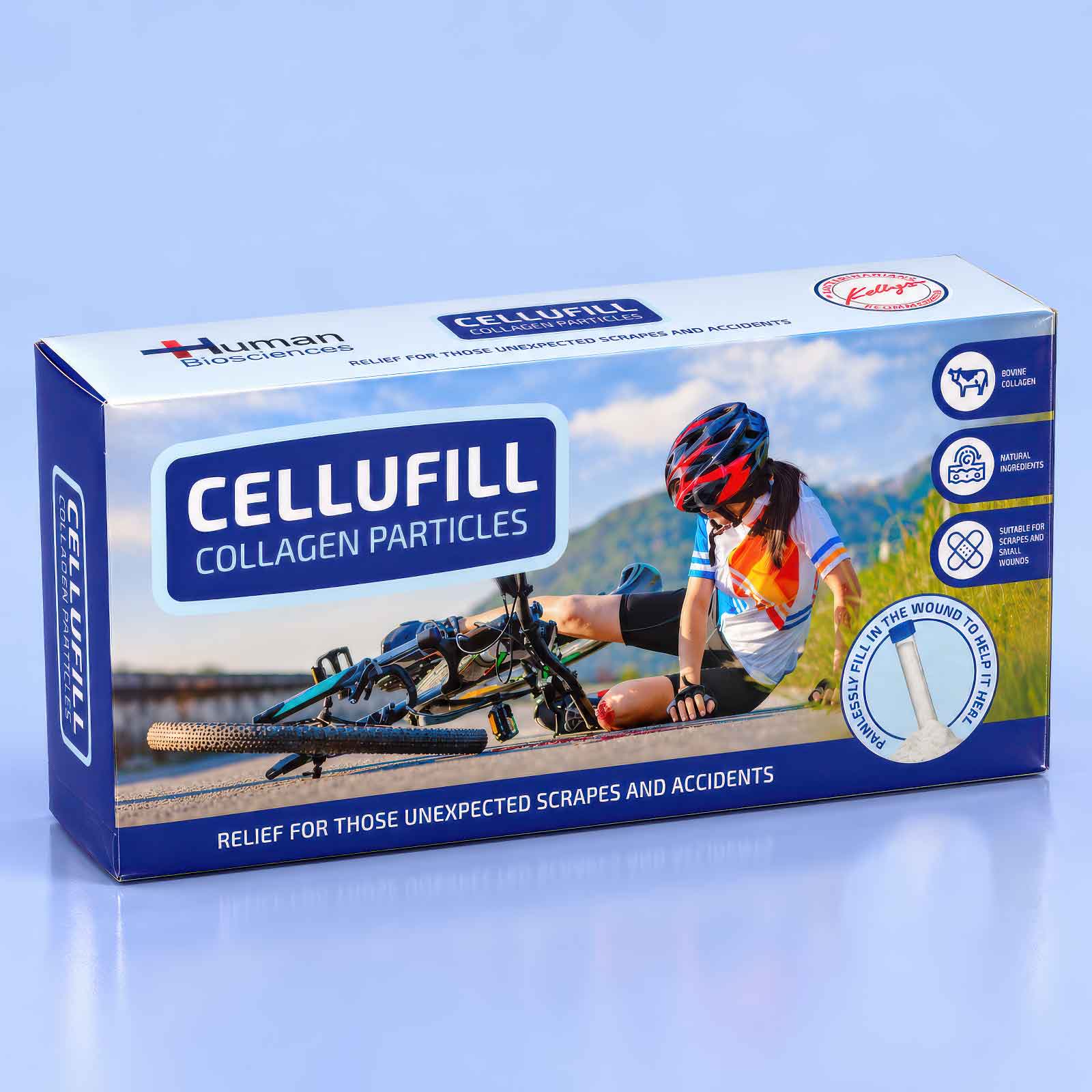
Packaging for Cellufill Collagen Particles, a collagen wound-care product from Human BioSciences for everyday scrapes and small wounds. The fall on the front of the box shows what the product is for before anyone reads a word.
About the product
Cellufill is made of 100% non-hydrolysed bovine collagen. It comes as sterile, off-white, water-loving micro-particles about 0.1 to 0.3 mm across, in single-use 1 gram vials. Because it is a loose powder, it can be sprinkled into uneven or awkward wounds where a flat dressing cannot make full contact. The particles absorb minor wound fluid, keep the area moist and act as a scaffold for new tissue.
It is meant for open scrapes, abrasions and small wounds. The wound is cleaned first, the particles are sprinkled on in an even layer, and a dressing holds them in place.

The concept
The pack tells its story in one glance. A cyclist has come off her bike, her knee is scraped, and the box promises “relief for those unexpected scrapes and accidents.” For a product that is essentially sterile powder in a vial, that is a smart move, because the photo explains the use case before anyone reads a word. The scene is relatable, active and slightly aspirational, which keeps a wound-care product away from the grim hospital look.
What works
The hero image. It shows the “unexpected” moment honestly, with the bike on its side and the scraped knee visible, without becoming gory. The sunny mountain road keeps the mood reassuring rather than frightening.
Colour. Deep navy with pale sky blue is the safe, trustworthy language of healthcare, and the photo’s blues and greens sit comfortably within it.
The name plate. The white and pale-blue type inside the rounded navy panel is the clearest thing on the pack. The product name and descriptor read in a fraction of a second, even at an angle.
The icon badges. Bovine collagen, natural ingredients and suitable for scrapes and small wounds are clean, consistent and quick to scan, and they give the key facts without clutter.
The vial callout. It shows what you actually get and how it is used, which is a nice piece of function-first design.